2 Union Square, Union City, CA 94587
contact@NeoBiotechnologies.com
510-376-5603


Catalog #
Size
Price (USD)
Formulation
Catalog No
Size
Formulation
Price (USD)

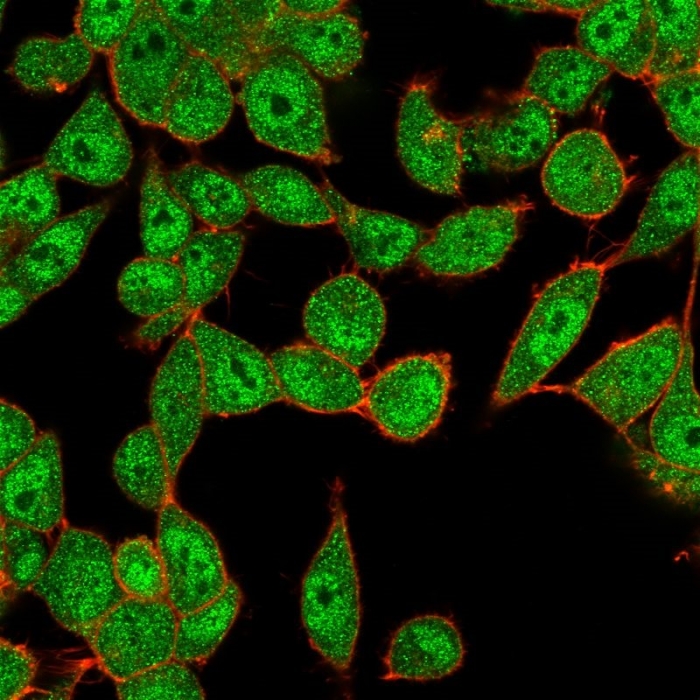

Flow Cytometric Analysis of PFA-fixed HeLa cells.UBE2B Mouse Monoclonal Antibody (PCRP-UBE2B-1C7) followed by goat anti-mouse IgG-CF488 (blue); unstained cells (red).

Immunofluorescent Analysis of PFA-fixed HeLa cells. UBE2B Mouse Monoclonal Antibody (PCRP-UBE2B-1C7) followed by IgG-CF488 (green), counterstained with phalloidin.

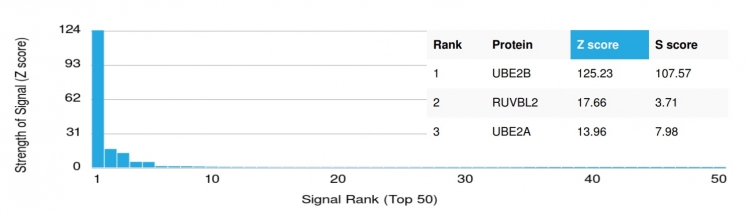
Analysis of Protein Array containing more than 19,000 full-length human proteins using UBE2B Mouse Monoclonal Antibody (PCRP-UBE2B-1C7).
Product Details
Synonyms
Positive Control
Known Applications & Suggested Dilutions
Immunogen
Cellular Localization
Species Reactivity
Host / Ig Isotype
Mol. Weight of Antigen
Specificity & Comments
The ubiquitin (Ub) pathway involves three sequential enzymatic steps that facilitate the conjugation of Ub and Ub-like molecules to specific protein substrates. The first step requires the ATP-dependent activation of the Ub C-terminus and the assembly of multi-Ub chains by the Ub-activating enzyme known as the E1 component. The Ub chain is then conjugated to the Ub-conjugating enzyme (E2) to generate an intermediate Ub-E2 complex. The Ub-ligase (E3) then catalyzes the transfer of Ub from E2 to the appropriate protein substrate. UBE2A (ubiquitin-conjugating enzyme E2 A) and UBE2B (ubiquitin-conjugating enzyme E2 B) are both Ub-conjugating enzymes that are essential to post replication repair of UV-damaged DNA. UBE2A and UBE2B are both nuclear and cell membrane proteins that have been found to interact with Rad18.
Key References
Bioinformatics


